
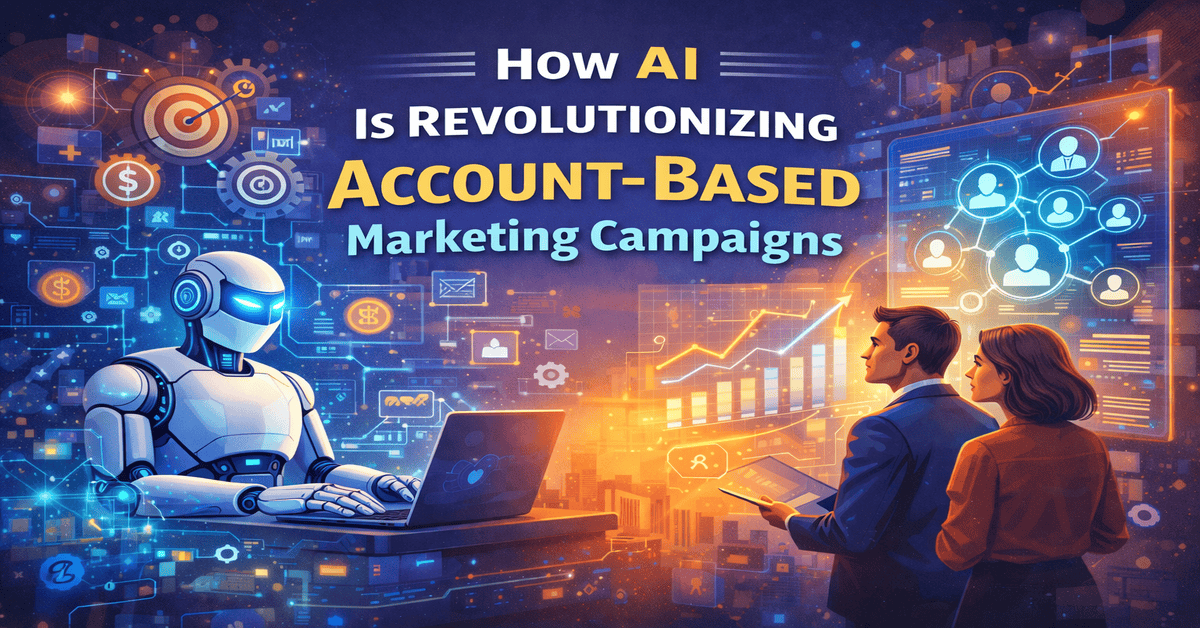
How AI Is Revolutionizing Account-Based Marketing Campaigns
Introduction
In the rapidly evolving world of B2B marketing, businesses are constantly searching for smarter ways to reach high-value prospects. Traditional lead generation often favors quantity over quality, which leads to wasted marketing budgets and low conversion rates.
This is where Account-Based Marketing (ABM) has transformed the landscape. Instead of targeting broad audiences, ABM focuses on engaging specific high-value accounts with highly personalized marketing campaigns.
Today, the integration of Artificial Intelligence (AI) is taking ABM to an entirely new level. AI enables marketers to analyze massive amounts of data, predict customer behavior, and deliver hyper-personalized experiences at scale. As a result, AI-driven ABM campaigns are becoming more efficient, data-driven, and impactful than ever before.
Understanding Account-Based Marketing (ABM)
Account-Based Marketing is a strategic approach where marketing and sales teams collaborate to target specific organizations or accounts that have the highest potential value.
Instead of generating thousands of generic leads, ABM focuses on:
- Identifying high-value companies
- Personalizing marketing messages
- Aligning sales and marketing strategies
- Building stronger relationships with decision-makers
This targeted approach significantly increases the chances of conversion and improves ROI. However, executing ABM campaigns manually can be complex and time-consuming, especially when dealing with long B2B buying cycles and multiple stakeholders. That is where AI technologies play a critical role.
The Role of AI in Modern ABM Campaigns
Artificial Intelligence helps marketers analyze complex datasets and uncover insights that would be difficult or impossible to identify manually.
AI improves ABM campaigns in several ways:
- Identifying high-intent accounts
- Predicting buying behavior
- Automating personalization
- Optimizing campaign performance
- Enhancing customer engagement
By integrating AI tools, businesses can scale their ABM strategies without sacrificing personalization or relevance.
AI-Powered Account Identification
One of the biggest challenges in ABM is identifying which companies are most likely to convert. AI algorithms analyze large datasets such as:
- Website behavior
- CRM data
- Firmographic data
- Engagement history
- Third-party intent signals
Using this information, AI can predict which accounts are actively researching solutions similar to your product or service. This allows marketing and sales teams to focus their efforts on prospects with the highest purchase intent, improving pipeline quality and sales efficiency.
Hyper-Personalization at Scale
Personalization is at the core of successful ABM campaigns. However, creating personalized content for hundreds of accounts manually is extremely difficult and resource intensive.
AI solves this challenge by enabling dynamic, behavior-based content personalization. AI can automatically customize:
- Email campaigns
- Website content
- Product or solution recommendations
- Ad messaging
- Content offers
For example, AI tools can tailor website experiences based on the visitor’s company size, industry, and on-site behavior, showing different messages or assets to different accounts. This creates a more relevant and engaging experience for each target account and can lead to higher engagement and conversion rates.
Predictive Analytics for Smarter Targeting
AI-driven predictive analytics allows marketers to anticipate future customer actions instead of reacting only to past behavior.
By analyzing historical data and behavioral patterns, AI can forecast:
- Which accounts are most likely to convert
- When a prospect is ready for sales outreach
- Which marketing channels perform best for specific accounts
- What content resonates most with decision-makers
These insights help marketing teams allocate resources more effectively and focus on strategies that drive measurable results.
AI-Driven Campaign Optimization
AI continuously monitors campaign performance and provides real-time insights across channels.
It can automatically optimize campaigns by:
- Adjusting ad targeting and bidding
- Refining audience segments
- Recommending better content or offers
- Improving email timing and frequency
This continuous, data-driven optimization helps marketers improve ROI, reduce wasted ad spend, and react quickly to changes in buyer behavior.
Improved Sales and Marketing Alignment
One of the key goals of ABM is to align marketing and sales teams around the same target accounts and success metrics.
AI tools provide a unified view of account engagement, enabling both teams to access valuable insights such as:
- Engagement scores
- Buying stage or intent stage
- Content interactions and channel touchpoints
- Key decision-maker activities
With this shared data, sales teams can approach prospects with more context, tailor their outreach, and have more meaningful conversations that connect directly to a prospect’s current priorities.
Benefits of AI-Powered ABM
Organizations that integrate AI into their ABM strategies experience several advantages:
- Higher conversion rates: AI identifies high-intent prospects and prioritizes the right accounts, increasing the likelihood of successful deals.
- Better personalization: AI enables customized messaging, offers, and journeys tailored to each account and buyer persona.
- Improved efficiency: Automation reduces manual effort in research, scoring, and orchestration, saving time for both marketing and sales teams.
- Data-driven decision making: AI insights allow marketers to continually test, measure, and optimize campaigns based on real performance data.
- Higher marketing ROI: Targeting the right accounts with relevant engagement ensures better use of budget and resources.
You could further strengthen this section by adding one or two benchmark statistics (for example, mention improvements in pipeline or engagement where studies are available).
Challenges to Consider
While AI offers numerous benefits, businesses should also consider certain challenges when implementing AI-powered ABM:
- Data quality and integration issues
- Dependence on accurate and unified CRM and marketing data
- Implementation and technology costs
- The need for skilled teams to manage data, tools, and strategy
- Governance and privacy considerations around intent and behavioral data
Organizations must ensure they have the right data infrastructure, governance, and cross-functional collaboration in place before scaling AI-driven ABM initiatives.
The Future of AI in Account-Based Marketing
The future of ABM will be heavily influenced by continued advancements in AI and machine learning.
Emerging innovations such as:
- AI-powered customer journey mapping
- More autonomous, self-optimizing campaign management
- Real-time, multi-channel personalization
- AI-generated marketing content and creative
- Privacy-first, ethical use of predictive signals
will make ABM campaigns even more intelligent, efficient, and buyer-centric. Businesses that adopt AI-driven marketing strategies early and invest in strong data foundations will gain a significant competitive advantage in the B2B marketplace.
Conclusion
Artificial Intelligence is transforming the way organizations approach Account-Based Marketing. By combining the precision of ABM with the analytical power of AI, businesses can identify high-value accounts, personalize engagement at scale, and optimize campaigns with unprecedented efficiency.
As B2B marketing becomes more competitive, AI-powered ABM will play a crucial role in helping companies build stronger relationships with target accounts and drive sustainable revenue growth. Organizations that invest in AI today will be better positioned to lead the future of data-driven, account-centric marketing.
Reference :
- https://www.marketo.com/articles/account-based-marketing/
- https://www.salesforce.com/resources/articles/account-based-marketing/
- https://www.hubspot.com/account-based-marketing
- https://www.forrester.com/blogs/account-based-marketing/
📩 Ready to harness WhatsApp stories for your business? Let’s talk.
📞 Call us: +91 9762910165
📧 Email:info@martechpanthers.com
🌐 Visit: https://martechpanthers.com/