
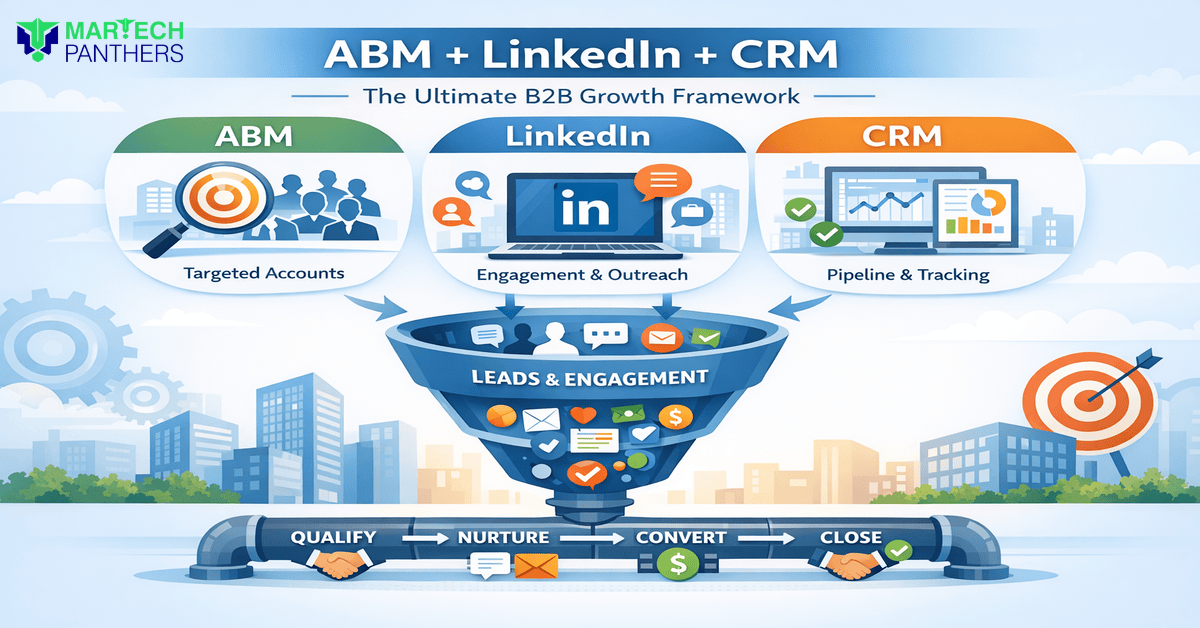
ABM + LinkedIn + CRM: The Ultimate B2B Growth Framework
Table of Contents
- Introduction
- Why Traditional B2B Marketing Is Failing
- Pillar 1: Account-Based Marketing (ABM)
- Pillar 2: LinkedIn – The ABM Engagement Engine
- Pillar 3: CRM – The Growth Backbone
- The Ultimate Framework: ABM + LinkedIn + CRM Together
- Real-World Example
- Why This Framework Is the Future of B2B Growth
- Final Thoughts
Blog Summary
This blog explains how combining Account-Based Marketing (ABM), LinkedIn, and CRM systems creates a powerful framework for modern B2B growth. It highlights why traditional lead-generation strategies are becoming less effective and how businesses are shifting toward targeted, relationship-driven marketing. The article explores the role of ABM in identifying high-value accounts, LinkedIn in building engagement and trust with decision-makers, and CRM systems in tracking interactions and managing sales processes. Together, these three elements help businesses improve personalization, align sales and marketing teams, accelerate conversions, and scale revenue more predictably. Overall, the blog positions this integrated approach as the future of sustainable and scalable B2B growth.
Introduction
In today’s competitive B2B world, traditional lead generation is no longer enough. Businesses are moving away from chasing random prospects and shifting toward a smarter, more focused approach.That’s where the combination of Account-Based Marketing (ABM), LinkedIn, and CRM systems becomes the ultimate framework for sustainable growth.Together, these three pillars help B2B companies:
- Target the right accounts
- Build meaningful relationships
- Convert decision-makers into long-term customers
- Scale revenue predictably
Let’s explore how this powerful trio works.
Why Traditional B2B Marketing Is Failing
For years, B2B marketing relied on volume-based strategies—collecting as many leads as possible through ads, email campaigns, and cold outreach.
But today, the challenges are different:
- Decision-making involves multiple stakeholders (averaging 6-7 buyers)
- Buyers complete most research independently before engaging
- Trust and credibility matter more than ever
- Sales cycles average 60-120 days (or longer for enterprise deals)
This is why modern B2B growth requires a focused, account-first strategy.
Pillar 1: Account-Based Marketing (ABM)
Account-Based Marketing (ABM)—now used by 76-94% of B2B marketers—focuses on a specific set of high-value target accounts instead of marketing to everyone.
ABM flips the funnel:
Instead of → generating leads → qualifying them
You → identify key accounts → personalize engagement → close deals faster
Benefits of ABM
- Higher ROI (87% of marketers report better returns than other strategies)
- Personalized experiences for decision-makers
- Stronger alignment between sales and marketing (70% report improved collaboration)
- Faster pipeline acceleration and revenue growth
ABM ensures you’re spending time and budget only on accounts that truly matter.
Pillar 2: LinkedIn – The ABM Engagement Engine
LinkedIn, with over 1.3 billion members (310 million monthly active users), is the most powerful platform for B2B professionals—where decision-makers learn trends, evaluate vendors, and build trust.
How LinkedIn Supports ABM
- Account Targeting: Use LinkedIn Sales Navigator to identify CEOs, procurement heads, plant managers, and CXOs.
- Content That Builds Authority: Posting regularly about industry insights positions your brand as a trusted expert.
- Personalized Outreach: Enable warm conversations through comments, DMs, and mutual connections
- Retargeting and Ads: Hyper-target ABM campaigns for specific companies and job titles.
LinkedIn helps engage target accounts before they enter your funnel.
Pillar 3: CRM – The Growth Backbone
A CRM (Customer Relationship Management) system makes your ABM strategy measurable and scalable—tracking interactions via seamless LinkedIn integrations (e.g., auto-save leads/accounts).
With CRM, you can:
- Track account activity
- Monitor engagement
- Automate follow-ups
- Align sales and marketing efforts
CRM’s Role in the ABM Framework
Key features include account-level dashboards, pipeline visibility, lead scoring, deal forecasting, and customer retention workflows.
The Ultimate Framework: ABM + LinkedIn + CRM Together
Individually powerful, combined they create a complete B2B growth engine.
Step1: Identify High-Value Target Accounts(ABM)
Select companies matching your Ideal Customer Profile (ICP). Examples: manufacturing enterprises, energy and hydrogen sector companies, SaaS mid-market firms.
Step 2: Engage Decision-Makers on LinkedIn
Build awareness through thought leadership, strategic commenting, direct outreach, and sponsored campaigns.
Step 3: Track and Nurture Through CRM
Capture every touchpoint (meetings, messages, engagement, deal progress) for seamless execution.
Step 4: Personalize and Convert Faster
Use CRM insights + LinkedIn data for 1-to-1 conversations.
Step 5: Scale Revenue Predictably
Expand account lists, automate workflows, and strengthen retention.
Real-World Example
Targeting industrial gas companies:
- ABM identifies the top 50 high-value accounts
- LinkedIn builds awareness via content + outreach
- CRM tracks engagement and advances pipeline stages
Result: More qualified meetings, faster conversions, stronger relationships.
Why This Framework Is the Future of B2B Growth
The B2B market evolves toward precision targeting, relationship-driven selling, data-backed personalization, and account expansion—with ABM adoption surging past 70%.
Final Thoughts
The answer isn’t more leads—it’s better accounts, stronger relationships, and smarter systems.
By combining:
- ABM for focus
- LinkedIn for engagement
- CRM for execution
You create the ultimate engine for scalable, predictable B2B growth.
Reference :
- https://blog.hubspot.com/marketing/account-based-marketing
- https://www.demandbase.com/abm/account-based-marketing/
- https://www.forrester.com/report/the-state-of-abm/
- https://www.hubspot.com/products/crm
📩 Ready to harness WhatsApp stories for your business? Let’s talk.
📞 Call us: +91 9762910165
📧 Email:info@martechpanthers.com
🌐 Visit: https://martechpanthers.com/