
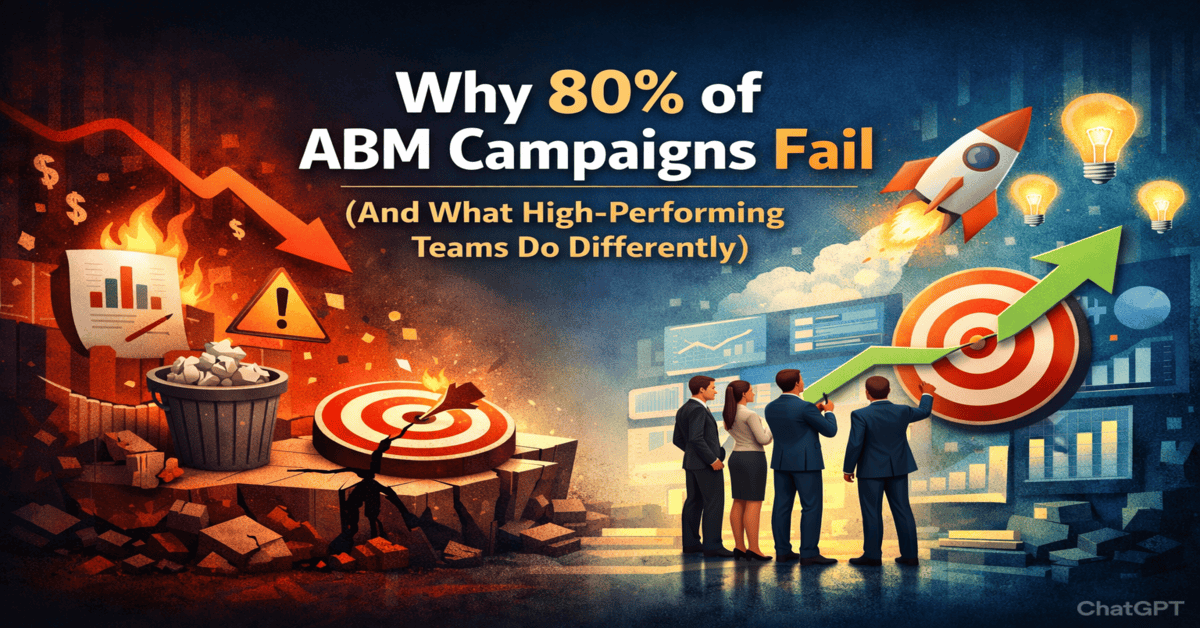
Why 80% of ABM Campaigns Fail (And What High-Performing Teams Do Differently)
Account-Based Marketing (ABM) has become one of the most powerful growth strategies in B2B.
It promises:
- Higher ROI
- Better alignment between sales and marketing
- Larger deal sizes
- Stronger customer relationships
Yet despite its popularity—94% of B2B marketers now use ABM in some form—most campaigns fail to deliver expected results. Industry reports indicate that 70-80% of ABM initiatives underperform or stall, with studies like ITSMA/TechTarget showing 66% failing to drive significant revenue improvement and recent analyses pegging ~80% below expectations.
Why does this happen?
And more importantly—what do high-performing ABM teams do differently?
Let’s break it down.
Why Most ABM Campaigns Fail
- Treating ABM Like Just Another Marketing Campaign
Many companies claim they are doing ABM, but they run targeted ads without deeper strategy. True ABM is a revenue strategy, not a short-term campaign—treating it as marketing activity alone leads to failure. - Poor Sales and Marketing Alignment
ABM only works when sales and marketing operate as one team. Failing programs see marketing selecting accounts without sales input, sales ignoring engagement data, and no shared KPIs. High-performers build joint plans, revenue goals, and weekly syncs—misalignment causes up to 10% revenue slippage. - Targeting the Wrong Accounts
Poor selection is a top killer: targeting unready companies, chasing logos over intent, or ignoring signals. Without intent data and research, campaigns flop. - Lack of Deep Personalization
Surface tweaks like company names in emails aren’t enough. Effective ABM demands industry messaging, custom propositions, account content, and landing pages. - No Clear Measurement Framework
Don’t measure clicks or impressions—focus on account engagement, pipeline velocity, deal size, and revenue influence. Wrong metrics hide true failure.
What High-Performing ABM Teams Do Differently
- Start With Revenue, Not Marketing Metrics:
Top teams reverse-engineer from revenue targets, strategic accounts, and expansions. - Use Intent Data & Smart Targeting:
They leverage buying signals, CRM insights, past data, and predictive analytics for in-market accounts. - Personalize at Scale:
Tech enables dynamic ads, sequences, website experiences, and scripts—structured, not random. - Align Sales, Marketing & Leadership:
Shared dashboards, CRM tracking, planning, and executive buy-in make ABM company-wide. - Think Long-Term:
Programs run 6-12 months (or 12-18 for ROI), nurturing via multi-touch for enterprise cycles.
The Real Reason 80% of ABM Campaigns Fail
It’s not ABM—it’s underestimating the strategy, expecting quick wins, team misalignment, and poor measurement. Done right, ABM delivers larger deals (up to 58% bigger), 234% faster pipeline progression, and superior ROI.
Final Thoughts
ABM is powerful as a strategic growth engine.
If underperforming, check alignment, targeting, personalization, and revenue metrics.
High-performers build account-centric systems—that’s scalable success.
Reference :
- https://blog.hubspot.com/marketing/account-based-marketing
- https://www.salesforce.com/resources/articles/account-based-marketing/
- https://www.itsma.com/page/abm
- https://www.demandbase.com/resources/
📩 Ready to harness WhatsApp stories for your business? Let’s talk.
📞 Call us: +91 9762910165
📧 Email:info@martechpanthers.com
🌐 Visit: https://martechpanthers.com/