
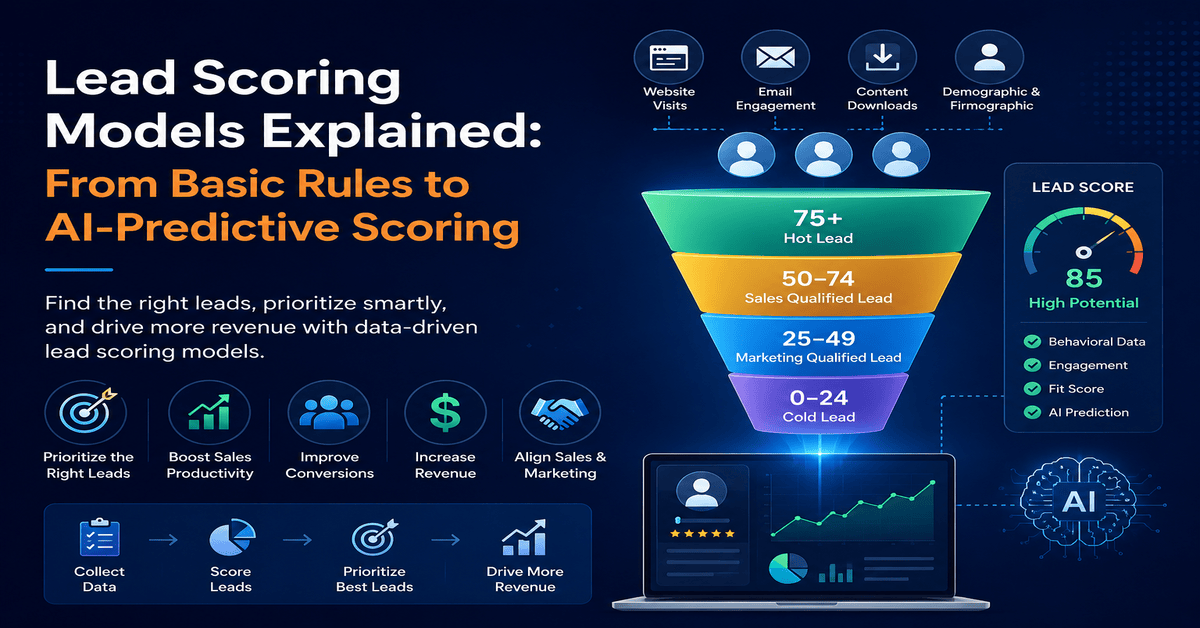
Lead Scoring Models Explained: From Basic Rules to AI-Predictive Scoring
Table of Contents
- Introduction
- What Is Lead Scoring?
- Why Modern B2B Companies Need Lead Scoring
- Types of Lead Scoring Models
- Traditional Rule-Based vs Predictive AI Lead Scoring
- How HubSpot Lead Scoring Works
- Common Lead Scoring Mistakes
- How to Build a Winning Lead Scoring Framework
- Lead Scoring Best Practices
- Is Your Lead Scoring System 2026-Ready?
- Real B2B Lead Scoring Example
- When Should You Switch to AI Lead Scoring?
- Frequently Asked Questions (FAQs)
- Conclusion
Blog Summary
Lead scoring is a critical process that helps businesses identify and prioritize the most sales-ready prospects by evaluating both customer attributes and engagement behavior. This blog explains the key lead scoring models used in modern B2B marketing, including demographic, firmographic, behavioral, engagement-based, product usage, negative, and AI-powered predictive scoring. It also explores the differences between traditional rule-based scoring and predictive AI models, highlights how HubSpot supports lead scoring, and outlines common mistakes businesses should avoid. By implementing a structured lead scoring framework, organizations can improve sales productivity, increase conversion rates, align sales and marketing teams, and maximize revenue growth.
Introduction
Your sales team has a hundred leads in the queue this week. Maybe five of them will actually close. The problem isn’t that marketing isn’t generating leads — it’s that nobody has a reliable way to tell the five real buyers apart from the ninety-five who are just browsing.
That’s exactly the gap lead scoring is built to close. It’s a system for ranking leads by how likely they are to buy, so sales spends time on the right accounts instead of working through a list in the order it arrived.
In this guide, you’ll learn what lead scoring actually is, every major lead scoring model B2B teams use today, how HubSpot handles scoring behind the scenes, the mistakes that quietly sabotage most scoring systems, and a step-by-step framework for building one that holds up.
What Is Lead Scoring?
Lead scoring is a method of assigning points to a lead based on two things: who they are (their role, industry, company size) and what they do (page visits, downloads, demo requests). Add the points up, and you get a score that tells you how sales-ready that lead actually is.
Here’s a simple example. A marketing director at a 200-person SaaS company who’s visited your pricing page twice and requested a demo looks very different from a student who downloaded one ebook and never came back. Without scoring, both show up in your CRM looking identical. With scoring, one gets a same-day call and the other gets added to a nurture sequence.
Quick Summary: Scoring turns a flat list of contacts into a prioritized one, so your busiest resource — your sales team’s time — goes where it actually counts.
Why Modern B2B Companies Need Lead Scoring
Buyers today do most of their research before they ever talk to sales. By the time someone fills out a form, they could be at the very start of their journey or three weeks from signing a contract. Lead scoring is how you tell the difference.
- Sales productivity. Reps stop guessing which leads to call first and start working from a ranked list.
- Higher conversions. Faster follow-up on genuinely hot leads means fewer of them go cold waiting in a queue.
- Better marketing ROI. When marketing can show which campaigns produce high-scoring leads, budget conversations get a lot easier.
- Faster pipeline movement. Qualified leads reach sales sooner, shortening the overall sales cycle.
- Revenue alignment. Scoring gives sales and marketing a shared, objective definition of “qualified.”
Types of Lead Scoring Models
There’s no single “right” lead scoring model. Most companies end up combining several. Here’s what each one actually does.
1. Demographic Scoring
Looks at individual-level traits: job title, seniority, department, and location. Pros: easy to apply, available from the form submission. Cons: tells you nothing about intent. Example: a “VP of Sales” lead scores higher than an “Intern,” regardless of behavior.
2. Firmographic Scoring
Evaluates the company, not the individual — industry, size, revenue, tech stack. Example: if your product targets mid-market manufacturers, a 300-person manufacturing lead outscores a 5-person agency. Best for: account-based marketing programs.
3. Behavioral Scoring
Tracks what a lead actually does: website visits, email opens, content downloads, pricing page visits, demo requests. Behavioral signals often reveal intent earlier than any form field could.
4. Engagement Scoring
Weighs how recently and how often someone engages, not just total count. A lead who engaged five times last week should outrank one who engaged twenty times across the past year.
5. Product Usage Scoring
For SaaS companies with free trials or freemium plans, in-app behavior — feature adoption, active seats, login frequency — is often the strongest conversion signal of all.
6. Negative Scoring
Subtracts points for red flags: spam fills, student or personal email domains, competitor domains, long inactivity, unsubscribes. Without it, every lead eventually looks “qualified.”
7. Predictive AI Lead Scoring
Uses machine learning to analyze historical closed-won and closed-lost deals and surface patterns a human would likely never spot manually. Instead of a marketer guessing point values, the model continuously recalculates weights based on real outcomes — the engine behind modern AI lead scoring B2B strategies.
The model weighs historical win/loss patterns against new leads, scoring each one in real time.
Expert Tip: Predictive scoring needs fuel. Without at least 6–12 months of clean, structured deal history, an AI model won’t have enough signal to learn from yet.
Traditional Rule-Based vs Predictive AI Lead Scoring
| Factor | Rule-Based Scoring | Predictive AI Scoring |
| Setup | Fast, manual configuration | Slower — needs historical data |
| Accuracy | Fixed, depends on who built it | Improves continuously over time |
| Scalability | Struggles at high volume | Built for scale |
| Maintenance | Ongoing manual updates | Largely self-adjusting |
| Speed to value | Immediate | Delayed until trained |
| Learning capability | None — static rules | Learns automatically |
| Best for | Early-stage, small datasets | Mature, clean CRM data |
| Cost | Lower | Higher (data prep + tooling) |
Bottom line: rule-based scoring is the right starting point for most companies. Predictive AI scoring is the right next step once you have the data to support it.
How HubSpot Lead Scoring Works
HubSpot is the platform we most often implement lead scoring inside, since it supports both manual rules and predictive scoring within the same CRM.
A high score doesn’t just sit in HubSpot — it triggers lifecycle changes, alerts, and a task automatically.
- Score Property: build a custom score property instead of relying on HubSpot’s default — full visibility into how a number was calculated.
- Behavioral & Negative Rules: workflows add or subtract points based on triggers like page views, form fills, or bounced emails.
- Predictive Scoring: on higher-tier plans, machine learning surfaces the leads most likely to close.
- Cross-Hub Sync: a score crossing a threshold can trigger a nurture sequence, a sales task, and a CRM notification simultaneously.
Best Practice: Map your score thresholds to lifecycle stages (Subscriber → MQL → SQL) so scoring actively moves leads through your funnel instead of sitting as a number on a contact record.
Common Lead Scoring Mistakes
- Treating every action as equal. A blog read and a demo request shouldn’t carry the same weight. Fix: weight high-intent actions far higher.
- Skipping negative scoring. Scores only go up and everyone eventually looks qualified. Fix: deduct for poor fit and inactivity.
- No shared definition of “qualified”. The root cause of most lead-quality complaints. Fix: build the model with sales using real data.
- Static thresholds. Buyer behavior shifts; static thresholds don’t. Fix: recalibrate quarterly.
- Relying on CRM defaults. Out-of-the-box scoring rarely fits your buyer journey. Fix: build a custom score property.
- No score decay. Old engagement shouldn’t weigh the same as recent activity. Fix: add time-based decay.
- Ignoring firmographic fit. A highly engaged lead from a bad-fit company is still a poor lead. Fix: layer firmographics on top of behavior.
- Jumping to AI without clean data. Messy data trains messy predictions. Fix: fix data hygiene first.
- No automated handoff. A score nobody acts on is wasted. Fix: automate routing and alerts.
- Never auditing outcomes. Without checking conversions by score band, you can’t know if it works. Fix: run quarterly win-rate audits.
How to Build a Winning Lead Scoring Framework
- Pull your last 20–30 closed-won deals and look for shared traits.
- Define qualification criteria — firmographic/demographic fit plus behavioral engagement.
- Assign point values, weighted by intent. Pricing visits and demo requests outweigh a single blog read.
- Build negative scoring rules for poor fit and disengagement.
- Set tiered thresholds, not just one cutoff.
- Automate the handoff — lifecycle stage changes, notifications, tasks.
- Review quarterly against real deal outcomes.
| Score Range | Classification |
| 0–24 | Cold Lead |
| 25–49 | Marketing Qualified Lead (MQL) |
| 50–74 | Sales Qualified Lead (SQL) |
| 75+ | Hot Lead — Priority Outreach |
Best Practices
- Build the model with sales, not just for sales.
- Centralize your data — scattered spreadsheets break accurate scoring.
- Layer in intent data where available.
- Prioritize first-party data as third-party tracking erodes.
- Automate the handoff, not just the score.
- Revisit the model every quarter, not once a year.
Checklist — Is Your System 2026-Ready?
- Reviewed with sales in the last 90 days
- Negative scoring rules in place
- Custom score property (not relying on defaults)
- Score thresholds mapped to lifecycle stages
- Sales notifications automated
- Quarterly audit scheduled
Real B2B Example
A mid-sized B2B SaaS company came to us with a familiar problem: marketing was generating plenty of form-fills, but sales had quietly stopped trusting the “MQL” label altogether.
Before Scoring
- Every submission treated the same
- Leads worked in arrival order, not fit
- Time-to-first-contact: 2+ days
- Win rate on “qualified” leads: under 8%
After Scoring
- Model rebuilt around fit + weighted behavior
- Negative scoring for poor-fit domains
- Time-to-first-contact: under 2 hours
- SQL win rate roughly doubled in 2 quarters
When Should You Switch to AI Lead Scoring?
AI scoring isn’t a starting point — it’s a graduation point. Consider the move when:
- You have 6–12+ months of clean, structured deal data
- Your rule-based model is validated but still feels limited
- Lead volume has outgrown manual rule maintenance
- Sales and marketing already trust the existing system
Warning: Missing two or more of the conditions above? Strengthen your rule-based foundation first. AI scoring amplifies whatever data you feed it — good or messy.
Frequently Asked Questions
What is lead scoring in simple terms?
It’s a way of ranking leads with points based on who they are and what they do, so sales knows which ones to prioritize.
What’s the difference between behavioral and demographic scoring?
Behavioral scoring tracks actions like visits, downloads, and demos, while demographic scoring evaluates who the lead is — job title, seniority, location.
Is predictive AI lead scoring better than rule-based scoring?
Not automatically. It’s more powerful with enough clean historical data, but rule-based scoring is often more practical for newer companies.
How many points should a lead need to become an MQL?
There’s no universal number. Most teams start around 25–50 points on a 100-point scale and adjust based on real conversion data.
Does HubSpot offer built-in lead scoring?
Yes — a default score property plus the ability to build fully custom scoring and predictive models on higher-tier plans.
What is negative lead scoring, and why does it matter?
It subtracts points for disqualifying signals like competitor domains or inactivity, preventing low-fit leads from looking falsely qualified.
How often should a lead scoring model be updated?
At minimum, quarterly — buyer behavior and product offerings shift faster than most static models account for.
Can small B2B companies use predictive AI scoring?
Only once they’ve accumulated enough clean historical deal data — typically 6–12 months at minimum. Before that, rule-based scoring is the better fit.
What’s the biggest mistake companies make with lead scoring?
Building it once and never revisiting it — or never validating it against real won/lost outcomes in the first place.
Does lead scoring work without a CRM?
Technically yes, but it’s far less reliable. A CRM centralizes the behavioral and firmographic data that scoring depends on.
Conclusion
Lead scoring isn’t about adding complexity for its own sake — it’s about giving sales a reliable answer to one question: who should we call first? Whether you’re rolling out your first rule-based model or layering predictive AI on top of a year of clean CRM data, the goal stays the same: turn a flat list of leads into a ranked one that actually reflects buying intent.
If your current scoring setup feels more like a guess than a system, that’s usually the clearest sign it’s time for a closer look.
References:
blog.hubspot.com/marketing/ai-marketing
About Martech Panthers
Martech Panthers is a leading marketing technology and CRM solutions company that helps businesses drive growth through automation, data-driven strategies, and digital transformation. The company specializes in CRM implementation, HubSpot consulting, marketing automation, email marketing, WhatsApp marketing, LinkedIn outreach, website development, and seamless system integrations. By combining innovative technology with strategic expertise, Martech Panthers enables organizations to streamline operations, enhance customer engagement, and maximize marketing ROI. With a strong commitment to client success and business growth, Martech Panthers empowers companies to build scalable, future-ready digital ecosystems.
📩 Ready to harness WhatsApp stories for your business? Let’s talk.
📞 Call us: +91 9762910165
📧 Email:info@martechpanthers.com
🌐 Visit: https://martechpanthers.com/