
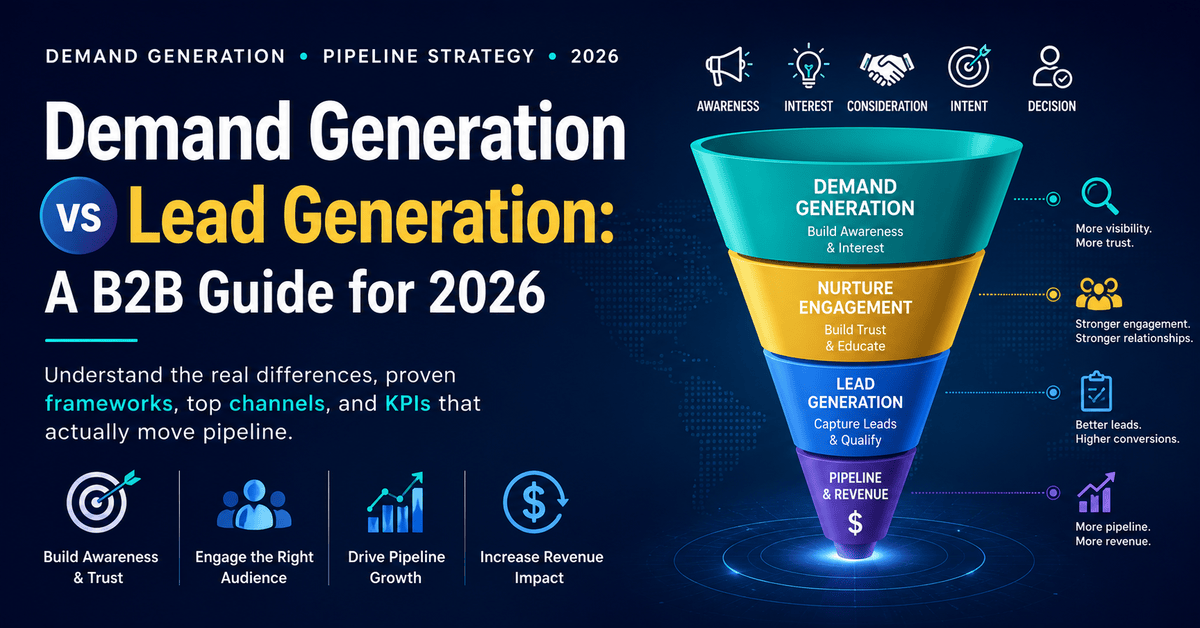
Demand Generation vs Lead Generation: A B2B Guide for 2026
Table of Contents
- Introduction: The Confusion That’s Costing You Pipeline
- What Is Demand Generation?
- What Is Lead Generation?
- Demand Generation vs Lead Generation: The Real Difference
- Why Modern B2B Companies Focus on Demand Generation First
- Why MQLs Are Becoming Less Important
- Demand Generation Framework for 2026
- Demand Generation Channels That Work in 2026
- Best Demand Generation KPIs to Track
- 10 Common Demand Generation Mistakes
- A Real B2B SaaS Demand Generation Example
- How MarTech Panthers Helps
- Frequently Asked Questions
- Conclusion
Blog Summary
This guide breaks down demand generation vs lead generation in plain language, so your team stops chasing the wrong number. You’ll get a clear definition of each motion, a side-by-side comparison table, a step-by-step demand generation framework built for 2026, the channels and KPIs that actually move pipeline, and the mistakes that quietly cap most B2B teams’ growth.
Introduction: The Confusion That’s Costing You Pipeline
Walk into almost any B2B marketing team’s Monday pipeline review, and you’ll hear the same two phrases used interchangeably: “demand gen” and “lead gen.” On paper, that seems harmless. In practice, it’s one of the most expensive mix-ups in modern marketing.
When a team treats demand generation as just another word for lead generation, it starts measuring the wrong things. Budget flows toward gated ebooks and form-fill ads instead of the awareness and trust-building work that actually creates buyers in the first place. Sales complains about lead quality. Marketing points to a dashboard full of MQLs that never convert. Everyone is busy, and pipeline still doesn’t grow the way it should.
This guide exists to clear that confusion up for good. We’ll define both terms precisely, show you exactly where they overlap and where they diverge, and give you a practical demand generation framework you can start applying this quarter — whether you’re running a five-person marketing team or a full revenue operations org.
What Is Demand Generation?
Demand generation is the set of marketing activities that create awareness, interest, and trust in your category and your company — long before anyone is ready to talk to sales. It’s the work that makes a buyer think, “I have a problem, and I’ve heard of a company that solves it well,” months before they ever fill out a form.
Done well, demand generation strategy doesn’t chase leads. It builds a reputation. It shows up in the research a buyer does entirely on their own — reading comparison content, listening to a podcast, seeing a LinkedIn post from your VP of Sales, or noticing your brand mentioned in a peer Slack community. None of that activity gets captured by a form fill, but all of it shapes the shortlist.
- Goal: Build category awareness, credibility, and buyer intent at scale
- Primary output: Educated, warm audiences — not necessarily contact records
- Time horizon: Weeks to quarters; compounding over time
- Success signal: Branded search volume, engaged accounts, pipeline influenced
Expert Tip: If you can’t explain how a piece of content builds trust or awareness even for someone who never fills out a form, it’s probably a lead gen asset wearing a demand gen label.
What Is Lead Generation?
Lead generation is the narrower, more tactical job of converting interest into a contact record your sales team can act on. It’s forms, gated content, free trials, demo requests, and outbound sequences — anything designed to capture a name, an email address, or a phone number.
Lead generation examples include a gated whitepaper download, a “Request a Demo” button, a webinar registration form, or a cold outbound campaign targeting a defined ICP list. Each of these has one clear objective: turn an anonymous visitor into a known contact that sales or nurture marketing can follow up with.
- Goal: Capture contact information from interested prospects
- Primary output: Leads, form fills, MQLs, booked meetings
- Time horizon: Days to weeks; immediate and campaign-driven
- Success signal: Cost per lead, form conversion rate, MQL volume
Neither motion is “better” than the other — they answer different questions.
- Demand generation answers: “Does the market know and trust us?”
- Lead generation answers: “Can we identify who’s ready to talk?”
The problem starts when a team runs only one of the two.
Demand Generation vs Lead Generation: The Real Difference
The clearest way to separate demand generation vs lead generation is to line them up side by side across the dimensions that actually matter to a revenue team: funnel stage, KPIs, content, channels, and how ROI gets measured.
Comparing Demand Gen and Lead Gen Across the B2B Funnel
| Dimension | Demand Generation | Lead Generation |
| Goal | Build awareness, trust, and category demand | Capture identifiable, actionable contacts |
| Funnel Stage | Top and mid-funnel (TOFU/MOFU) | Mid and bottom-funnel (MOFU/BOFU) |
| Primary KPIs | Branded search, share of voice, pipeline influenced | Cost per lead, form conversion rate, MQL volume |
| Content Type | Ungated thought leadership, research, video, podcasts | Gated ebooks, case studies, webinars, product content |
| Channels | SEO, LinkedIn organic, communities, PR, events | Paid search, retargeting, email capture, outbound |
| Metrics Owner | Brand and content marketing | Growth marketing and SDR/BDR teams |
| Timeline to Impact | Months to compound; slower to attribute | Days to weeks; fast and campaign-bound |
| Buyer Intent | Latent — building intent before it’s declared | Declared — buyer has already raised a hand |
| Technology | Intent data, ABM platforms, content analytics | CRM, marketing automation, landing page tools |
| ROI Measurement | Pipeline influence, revenue attribution over time | Cost per acquisition, conversion rate, speed to lead |
Lead generation moves prospects down a linear funnel; demand generation builds a compounding flywheel of awareness, trust, and pipeline.
Notice the shape difference in the diagram above. A lead gen funnel resets every month — you fill the top, and a fraction reaches the bottom. A demand generation strategy behaves more like a flywheel: every piece of content, every mention, every trust signal makes the next cycle spin a little easier. That’s why teams that only run lead gen eventually hit a ceiling, no matter how much they optimize the funnel itself.
For more on how these motions relate to outbound-led approaches, see our breakdown of inbound vs outbound marketing, and how demand gen compares to a more targeted account-based approach in ABM vs demand gen.
Why Modern B2B Companies Focus on Demand Generation First
Five years ago, a B2B marketing team could get away with a lead-gen-only strategy: run paid ads, gate the content, hand MQLs to sales, repeat. That playbook is breaking down, and it’s not because paid ads stopped working. It’s because the buyer changed.
Research aggregating benchmarks from Forrester, Gartner, and 6sense shows B2B buyers now complete roughly 60–70% of their purchase journey independently, with buying committees averaging 11 to 14 internal stakeholders on complex purchases. That means by the time a lead fills out your form, a large share of the real decision-making has often already happened — in places your lead gen funnel never touched.
This is exactly why a pipeline generation strategy has to start earlier. If your only visibility into the buyer is the moment they submit a form, you’re arriving to the conversation after most of the influence has already been spent. Demand generation strategy exists to shape that earlier, invisible stage — so that when a buying committee finally does form, your company is already on the shortlist.
“The companies winning B2B deals in 2026 aren’t necessarily the ones with the biggest ad budgets. They’re the ones already being talked about in rooms they were never formally invited into.”
— Common framing among B2B revenue marketing practitioners
Revenue marketing strategy, at its core, is the recognition that marketing’s job isn’t just to fill a funnel — it’s to influence revenue outcomes across a much longer and messier buyer journey. That reframing is what’s pushing modern B2B pipeline generation upstream, into demand generation territory.
Why MQLs Are Becoming Less Important
For over a decade, the Marketing Qualified Lead (MQL) was the north star metric for B2B marketing teams. It’s losing that status — not because lead scoring got worse, but because the environment it was built for has changed.
Buying Committees, Not Single Buyers
Gartner’s research on B2B buying groups shows they now range from five to sixteen people across as many as four functions, each with differing priorities and opinions. A single MQL was never designed to represent a group decision like that. One form fill from one persona tells you almost nothing about whether the other nine stakeholders in the room are convinced.
The Dark Funnel Is Where Buyers Actually Are
A growing share of buyer research now happens in places your analytics can’t see — private Slack communities, peer recommendations, review sites, podcasts, and increasingly, conversations with AI research tools. Marketers call this the “dark funnel,” and it’s a major reason MQL volume alone is a misleading signal: a buyer can be deep in evaluation long before they ever generate a trackable MQL event.
Intent Signals Beat Form Fills
Intent-based marketing platforms can now surface account-level research activity — content consumption, review-site visits, competitor comparisons — before a single form is submitted. That gives revenue teams an earlier, richer signal than “did this one person download a PDF.”
Revenue Attribution Is Moving Upstream
Instead of asking “how many MQLs did marketing generate,” mature revenue teams now ask “how much pipeline and revenue did marketing influence.” That single shift changes what gets funded, what gets measured, and what a demand gen team is actually accountable for.
Pipeline Velocity Matters More Than Lead Volume
A team generating fewer, better-fit MQLs that move quickly through the funnel will consistently outperform a team generating high MQL volume with a slow, leaky mid-funnel. Pipeline velocity — how fast qualified opportunities move to closed-won — is becoming a more trusted marketing KPI than raw lead count.
Expert Tip: Don’t kill your MQL metric overnight. Keep it as an operational signal for sales handoff, but stop reporting it to leadership as your primary measure of marketing’s impact on the business.
Demand Generation Framework for 2026
Here’s the demand generation framework we walk B2B clients through at MarTech Panthers. It’s built around eight stages, and every stage feeds the next — skip one, and the whole engine underperforms.
1. Audience Research
Go deeper than a persona slide. Interview real customers and lost deals to understand the specific triggers, objections, and language your buying committee actually uses.
2. Messaging
Build a message map for each buying committee role — economic buyer, technical evaluator, end user — so your content speaks to the whole room, not just one persona.
3. Content
Prioritize ungated, high-value content (original research, comparison guides, expert commentary) that builds trust in channels buyers already visit — not just gated conversion assets.
4. Distribution
Treat distribution as seriously as creation. SEO, LinkedIn, communities, and partner channels each need a dedicated plan — content without distribution doesn’t generate demand.
5. Automation
Layer in marketing automation and intent data to route signals to the right nurture track or sales alert, without slowing the buyer down with unnecessary friction.
6. Sales Alignment
Agree with sales on what “sales-ready” actually means beyond a lead score — including account engagement, buying-committee coverage, and intent signals.
7. Measurement
Track pipeline influence and revenue attribution alongside traditional funnel metrics, so demand generation gets credit for the deals it actually shaped.
8. Optimization
Review the full system quarterly — not just campaign performance. Kill what isn’t building pipeline, and reinvest in the channels and content proving durable.
Demand Generation Channels That Work in 2026
A modern demand generation strategy is never single-channel. Here’s how the highest-performing channels fit into a B2B SaaS demand generation mix:
A modern demand generation channel mix surrounds the brand with organic, paid, and community-driven touchpoints.
Choosing the Right Channel Mix
- SEO: Compounding organic visibility for problem-aware and comparison searches.
- LinkedIn: Organic thought leadership plus targeted ABM ad campaigns.
- Email: Long-term nurture for accounts not yet sales-ready.
- Webinars: Deep-dive education that builds trust with multiple committee members at once.
- Communities: Peer-driven credibility in Slack groups, forums, and review sites.
- Events: High-trust, in-person or virtual touchpoints for enterprise accounts.
- Video: Short-form and long-form content for discovery and consideration.
- Paid Media & Retargeting: Accelerates awareness and keeps your brand present through longer buying cycles.
- Partner Marketing: Borrowed trust from complementary vendors and integration partners.
LinkedIn’s own research finds that 75% of B2B buyers use social media to inform a buying decision, with about half citing LinkedIn specifically as a trusted source — which is exactly why organic LinkedIn presence has become a non-negotiable demand gen channel rather than a “nice to have.”
Best Demand Generation KPIs to Track
If MQL volume alone isn’t the right north star, what should you track instead? Here are the demand generation KPIs we recommend prioritizing in 2026.
KPI Tracking Table
| KPI | What It Tells You | Review Cadence |
| Pipeline Influenced | Total opportunity value where marketing touched the deal | Monthly |
| Pipeline Velocity | How fast opportunities move from creation to closed-won | Monthly |
| Branded Search Volume | Awareness and category demand growth over time | Quarterly |
| Engaged Accounts (ABM) | Target accounts showing meaningful multi-touch engagement | Weekly |
| MQL-to-SQL Rate | Quality of leads passed from marketing to sales | Monthly |
| Content Engagement Depth | Time on page, scroll depth, repeat visits by account | Monthly |
| Customer Acquisition Cost | Total cost to acquire a customer across all channels | Quarterly |
| Win Rate on Influenced Deals | How marketing-touched deals convert vs. untouched ones | Quarterly |
Quick KPI Sanity Check
- Are you tracking pipeline influence, not just lead volume?
- Do you review MQL-to-SQL rate, not just raw MQL count?
- Is branded search volume on your dashboard at all?
- Can you tie any KPI back to closed-won revenue?
10 Common Demand Generation Mistakes
Even well-resourced B2B teams fall into these traps. Here are the ten we see most often:
1. Gating Everything
Locking every piece of content behind a form kills the top-of-funnel trust-building that demand generation depends on.
2. Optimizing Only for MQL Volume
Chasing lead count instead of lead quality inflates the top of the funnel and drains sales team morale.
3. Ignoring the Dark Funnel
If your attribution model only credits form fills, you’re systematically undervaluing the channels doing the real work.
4. Messaging to One Persona Only
A buying committee has multiple stakeholders — content built for a single persona misses most of the room.
5. No Sales and Marketing Alignment on Definitions
If sales and marketing don’t agree on what “sales-ready” means, every handoff creates friction and finger-pointing.
6. Treating Demand Gen as a Campaign, Not a System
One-off campaigns can spike interest briefly, but they don’t compound the way a consistent demand generation system does.
7. Underinvesting in Distribution
Teams spend 90% of their budget creating content and 10% distributing it — the ratio should be closer to even.
8. No Clear Owner for Pipeline Metrics
When no one owns pipeline influence as a metric, it quietly falls off the reporting dashboard entirely.
9. Copying Competitor Content Instead of Original Research
Generic, recycled content rarely earns the trust or search visibility that original data and perspective can.
10. Measuring ROI Too Early
Demand generation compounds over months, not days — judging it on a 30-day window almost always looks like underperformance.
A Real B2B SaaS Demand Generation Example
Consider a mid-market B2B SaaS company selling workflow automation software to operations leaders. For two years, their entire marketing motion was lead-gen only: gated ebooks, paid search, and a steady stream of MQLs handed to an SDR team. Pipeline was inconsistent, and every slow quarter triggered a scramble to “run more campaigns.”
The shift started with a simple audit: how much of their content was ungated, and how much branded search volume did they actually have? The answers were sobering — almost everything was gated, and branded search was flat year over year. There was no compounding asset building awareness independent of paid spend.
Over two quarters, the team rebalanced. They published ungated original research on industry benchmarks, built a consistent LinkedIn presence for their VP of Product, launched a monthly community-style roundtable for operations leaders, and kept just enough gated content (product comparisons, ROI calculators) to still capture clear buying-stage intent. Sales alignment shifted from “how many MQLs this week” to “which accounts are showing real engagement across multiple people.”
Within two quarters, branded search volume climbed, sales reported noticeably warmer first conversations, and pipeline influenced by marketing grew even though total MQL volume actually dropped. That’s the demand generation funnel doing its job — fewer, better leads, arriving with more context and trust already built.
How MarTech Panthers Helps
Building a demand generation engine touches nearly every part of your revenue stack — which is exactly why it’s so easy to get stuck. At MarTech Panthers, we help B2B teams connect the pieces: from CRM implementation that gives you clean account and contact data, to HubSpot consulting and marketing automation that turns intent signals into the right nurture path automatically.
We also work with teams on customer journey mapping to understand exactly where buying committees are getting stuck, and on revenue operations to make sure marketing, sales, and customer success are measuring pipeline the same way. If you’re specifically building out a demand generation program from scratch, our team can help design the framework, channel mix, and reporting structure end to end — without ripping out the tools you already rely on.
Frequently Asked Questions About Demand Generation vs Lead Generation
Q: What is the main difference between demand generation and lead generation?
A: Demand generation builds awareness, trust, and category demand before a buyer is ready to engage, while lead generation focuses on capturing contact information from people who have already shown declared interest. Demand gen is the “why they know you” layer; lead gen is the “how you get their details” layer.
Q: Should a B2B company focus on demand generation or lead generation first?
A: Most mature B2B teams run both, but demand generation should form the foundation, since it creates the awareness and trust that make lead generation campaigns convert better and cost less over time.
Q: How does demand generation work in practice?
A: Demand generation works by consistently publishing and distributing valuable, mostly ungated content across channels your buyers already trust, building brand recognition and intent well before a formal buying process begins.
Q: What is a good demand generation framework for 2026?
A: An effective 2026 framework covers eight stages: audience research, messaging, content, distribution, automation, sales alignment, measurement, and optimization, reviewed as a continuous cycle rather than a one-time project.
Q: Why are MQLs becoming less important as a marketing metric?
A: Buying committees have grown larger and buyers now complete much of their research anonymously, so a single MQL rarely reflects the full group decision. Marketing teams are shifting toward pipeline influence and account engagement as more reliable indicators.
Q: What are the best demand generation KPIs to track?
A: Pipeline influenced, pipeline velocity, branded search volume, engaged target accounts, and MQL-to-SQL conversion rate together give a far more complete picture than MQL volume alone.
Q: What channels work best for B2B demand generation?
A: SEO, LinkedIn organic content, email nurture, webinars, communities, and partner marketing tend to perform best for B2B demand generation, since they build trust over repeated exposure rather than relying on a single conversion moment.
Q: How is demand generation different from account-based marketing (ABM)?
A: Demand generation typically targets a broader audience to build category-wide awareness, while ABM applies a similar trust-building approach to a narrower, hand-picked list of high-value target accounts. Many B2B teams run both in parallel.
Conclusion: Build Demand, Then Capture It
The debate over demand generation vs lead generation isn’t really about picking a side — it’s about sequencing. Lead generation captures interest that already exists. Demand generation creates that interest in the first place. Skip the second one, and you’re stuck competing for a shrinking pool of buyers who already know they have a problem, while your competitors quietly build trust with everyone else.
If there’s one thing to take from this guide, it’s this: treat demand generation as the engine, and lead generation as the mechanism that turns that engine’s output into pipeline. Build both intentionally, measure them with the right KPIs, and give the system time to compound.
If you’re ready to build a demand generation strategy that doesn’t collapse the moment a campaign budget gets cut, MarTech Panthers can help you design the framework, tooling, and measurement model to make it happen.
References:
https://blog.hubspot.com/sales/lead-generation-vs-demand-generation?
https://www.gartner.com/en/documents/7271930?
About Martech Panthers
Martech Panthers is a leading marketing technology and CRM solutions company that helps businesses drive growth through automation, data-driven strategies, and digital transformation. The company specializes in CRM implementation, HubSpot consulting, marketing automation, email marketing, WhatsApp marketing, LinkedIn outreach, website development, and seamless system integrations. By combining innovative technology with strategic expertise, Martech Panthers enables organizations to streamline operations, enhance customer engagement, and maximize marketing ROI. With a strong commitment to client success and business growth, Martech Panthers empowers companies to build scalable, future-ready digital ecosystems.
📩 Ready to harness WhatsApp stories for your business? Let’s talk.
📞 Call us: +91 9762910165
📧 Email:info@martechpanthers.com
🌐 Visit: https://martechpanthers.com/