
Omnichannel vs Cross-Channel Marketing: What’s the Difference and Why It Matters
Table of Contents
- Introduction: The Confusion Costing B2B Marketers Revenue
- What Is Omnichannel Marketing?
- What Is Cross-Channel Marketing?
- Key Differences: Omnichannel vs Cross-Channel Marketing
- Why the Difference Matters for B2B SaaS Growth
- The Omnichannel Customer Journey, Mapped
- A Real B2B SaaS Example
- The Technology Stack Behind Omnichannel Marketing
- Common Mistakes Companies Make
- Framework: How to Transition from Cross-Channel to Omnichannel
- Frequently Asked Questions
- Conclusion
Blog Summary
This guide breaks down the real difference between omnichannel marketing and cross-channel marketing — two terms B2B SaaS teams use interchangeably, often at the cost of revenue. You’ll learn:
- What separates true omnichannel marketing from simple cross-channel presence
- Who this guide is for: RevOps leaders, CRM managers, CMOs, and growth teams scaling a multi-touch B2B buying journey
- The technology stack, framework, and metrics needed to move from disconnected channels to a unified customer experience
Introduction: The Confusion Costing B2B Marketers Revenue
Ask ten B2B marketing leaders whether their team runs an omnichannel marketing strategy, and most will say yes. Ask them to describe how a prospect’s experience actually connects across email, LinkedIn ads, the website, and a sales call — and the answer usually gets vague fast.
That gap is the whole problem. Omnichannel marketing and cross-channel marketing get used as synonyms in boardrooms, RFPs, and job descriptions, but they describe two fundamentally different operating models. One treats each channel as a connected extension of a single customer relationship. The other simply runs the same campaigns on more platforms.
The confusion isn’t just semantic. It shapes which martech tools get purchased, how budgets get allocated, and — most importantly — whether the customer experience actually feels coherent or disjointed. In a B2B buying journey that now spans an average of eight to ten touchpoints before a deal even reaches sales, that distinction determines whether marketing accelerates revenue or quietly adds friction to it.
By the end of this guide, you’ll know exactly where your organization sits on the cross-channel-to-omnichannel spectrum, what’s required to close the gap, and how to build a business case for doing it in 2026.
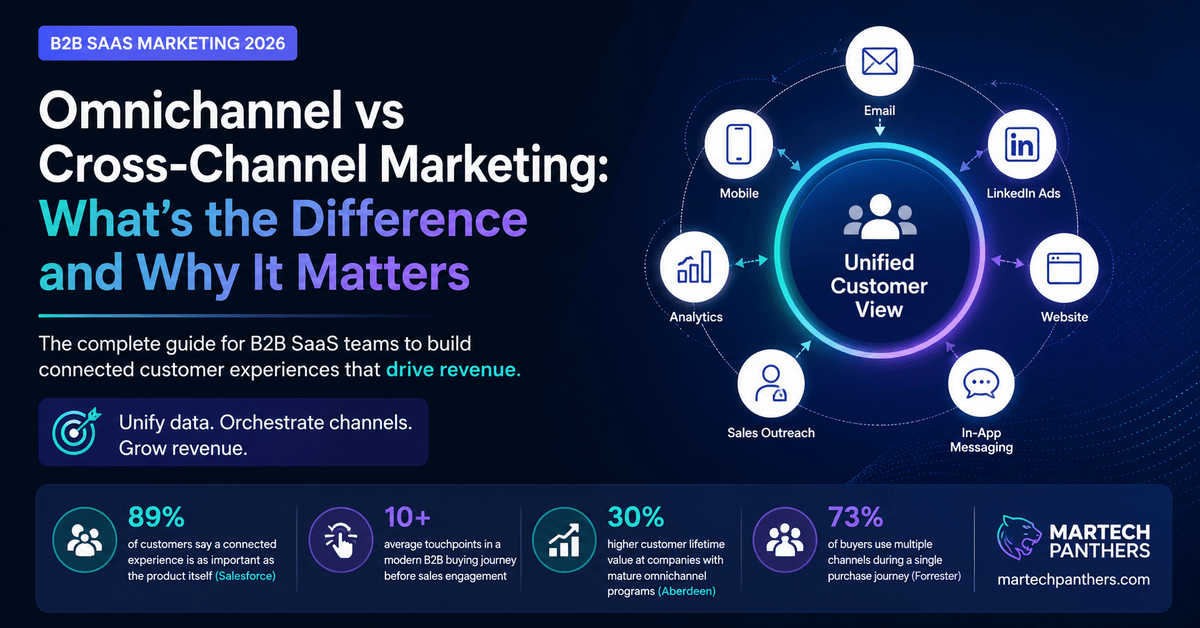
Key Industry Statistics
- 89% of customers say a connected experience is as important as the product itself (Salesforce)
- 10+ average touchpoints in a modern B2B buying journey before sales engagement
- 30% higher customer lifetime value at companies with mature omnichannel programs (Aberdeen)
- 73% of buyers use multiple channels during a single purchase journey (Forrester)
What Is Omnichannel Marketing?
Omnichannel marketing is a strategy where every channel — email, paid social, website, mobile, sales outreach, and in-product messaging — draws from a single, shared view of the customer and works together to move that customer forward. The channel changes. The context never resets.
In practice, this means a prospect who abandons a pricing page gets a follow-up ad referencing that exact plan, a sales rep who calls them already knows what content they’ve engaged with, and an email sequence adjusts automatically based on what happened on a call the day before. The customer experiences one continuous conversation, not five disconnected campaigns that happen to mention the same product.
Core Components of a True Omnichannel Marketing Strategy
- Unified customer data: A single record per account and contact, powered by a customer data platform (CDP) or well-integrated CRM.
- Channel orchestration: Coordinated timing and messaging logic across every channel, not channel-by-channel campaign planning.
- Real-time personalization: Content and offers that adapt based on the most recent interaction, regardless of which channel it happened on.
- Cross-functional visibility: Marketing, sales, and customer success all working from the same customer journey data.
- Closed-loop attribution: Multi-touch attribution models that credit the full path to conversion, not just the last click.
What Is Cross-Channel Marketing?
Cross-channel marketing means running coordinated campaigns across more than one channel — but each channel is typically planned, executed, and measured somewhat independently. There’s overlap and some shared branding or messaging, but the customer experience isn’t unified behind a single data layer.
Picture a product launch where the email team builds a nurture sequence, the paid media team runs a parallel LinkedIn campaign, and the web team updates the homepage — all pointed at the same goal, all using similar messaging, but none of them dynamically reacting to what a specific prospect does in another channel. That’s cross-channel marketing: multiple channels working in parallel, not in concert.
Where Cross-Channel Marketing Still Falls Short
Cross-channel marketing is a legitimate and often necessary stage for growing B2B teams. It’s usually where marketing automation and CRM integration efforts start. The limitation shows up at the customer level: without a shared data layer, a prospect can receive a “just discovered us” email the same week they’ve already had two sales calls, simply because the channels aren’t talking to each other in real time.
Key Differences: Omnichannel vs Cross-Channel Marketing
The clearest way to see the gap is side by side. Here’s how omnichannel marketing and cross-channel marketing compare across the dimensions that matter most to B2B SaaS teams.
| Dimension | Cross-Channel Marketing | Omnichannel Marketing |
| Customer Experience | Consistent branding, disconnected journeys | One continuous, connected journey |
| Data | Siloed by channel or platform | Unified via CDP / integrated CRM |
| Automation | Rule-based, channel-specific | Orchestrated across channels in real time |
| Personalization | Segment-level (industry, persona) | Individual, behavior-driven, adaptive |
| Measurement | Channel-by-channel reporting | Multi-touch attribution, full journey view |
| Scalability | Manual coordination limits scale | Scales through connected automation |
| Technology | Point solutions per channel | Integrated CDP, CRM, and marketing automation |
| ROI | Harder to prove incremental impact | Clearer, journey-level ROI |
Why the Difference Matters for B2B SaaS Growth
For B2B SaaS companies specifically, the stakes are higher than they look. Deal cycles are long, buying committees are large, and a single account might involve five or more stakeholders engaging across different channels at different times. Without an omnichannel marketing strategy, marketing and sales end up with fragmented, sometimes contradictory pictures of the same account.
This is also where cross-channel attribution starts to break down. If your reporting can’t connect a LinkedIn ad click, a webinar registration, and a sales call to the same buying committee, you’ll consistently underinvest in the channels doing the real work of moving a deal forward.
Where this shows up first
Revenue operations teams usually notice the gap before marketing does — mismatched lead status between systems, duplicate outreach to the same contact, or attribution reports that don’t match what sales says actually happened. If that sounds familiar, it’s a sign your stack needs customer data platform support before another campaign gets planned.
The Omnichannel Customer Journey, Mapped
Every channel connects back to a unified customer profile, so context carries forward no matter where the prospect engages next.
A true omnichannel customer journey isn’t a straight line — it’s a web of touchpoints that all report back to the same source of truth. A prospect might discover your company through a LinkedIn ad, research pricing on your website, attend a webinar, and finally convert after a personalized email triggered by their webinar attendance.
What makes this omnichannel rather than cross-channel is that each step informs the next automatically. The webinar attendance data doesn’t sit in a separate system waiting for someone to notice it — it triggers the next action without manual intervention.
This is the operational backbone that supports lifecycle marketing: prospects, customers, and renewals all move through connected, context-aware journeys instead of resetting with every new campaign.
A Real B2B SaaS Example
Consider a mid-market B2B SaaS company selling a project management platform. A VP of Operations clicks a LinkedIn ad about workflow automation, browses the pricing page, then leaves without converting.
In a cross-channel setup, that visitor might see a generic retargeting ad a few days later and, separately, get added to a general newsletter. The two experiences don’t know about each other.
In an omnichannel setup, that same visitor sees a retargeting ad referencing the specific feature page they viewed, receives a single follow-up email highlighting a relevant case study, and — if they engage again — automatically triggers a notification to their assigned sales rep with full context on what pages they viewed and when. When the rep calls, they already know exactly where the prospect’s interest lies, and the customer experience feels like one company paying attention, not several teams working in isolation.
The Technology Stack Behind Omnichannel Marketing
Omnichannel marketing isn’t achieved through willpower or better campaign planning alone — it requires the right technology foundation, integrated correctly. Here’s what that stack typically includes for B2B SaaS teams.
CRM
Your CRM remains the system of record for accounts, contacts, and deal stages. In an omnichannel setup, it needs to sync in near real time with marketing systems rather than through periodic batch updates — including for teams running Zoho implementation as their core CRM.
Marketing Automation
This is the orchestration layer — the system deciding what happens next across channels based on unified customer data, rather than running isolated, channel-specific workflows.
Customer Data Platform (CDP)
The CDP is what makes omnichannel marketing structurally possible. It ingests first-party data from every touchpoint and resolves it into a single customer identity, which every other tool in the stack can then read from and write to.
Analytics and Attribution
Multi-touch attribution models replace last-click reporting, giving credit across the full path to conversion and making it possible to actually see which combinations of channels move deals forward.
Sales Enablement
Sales tools need access to the same behavioral and engagement data marketing sees, so reps can personalize outreach based on real context instead of guessing.
Common Mistakes Companies Make
Mistake 1: Confusing More Channels With More Connection
Adding a new channel without integrating its data into the shared customer view increases complexity without increasing coherence.
Mistake 2: Letting Sales and Marketing Run Separate Playbooks
Omnichannel marketing breaks down the moment sales outreach isn’t informed by marketing engagement data, or vice versa.
Mistake 3: Measuring Channels Instead of Journeys
Channel-level dashboards can look healthy even while the end-to-end customer experience is fragmented. Journey-level metrics catch what channel reports miss.
Mistake 4: Skipping Data Governance
Unified data only helps if it’s accurate. Duplicate records and inconsistent field mapping quietly undermine even well-built orchestration logic.
Best Practices and Metrics That Matter
Teams that successfully make the shift tend to prioritize a small set of practices over a long list of tactics:
- Establish one shared definition of the customer journey across marketing, sales, and customer success.
- Invest in first-party data collection before adding new paid channels.
- Track journey-level metrics: time-to-conversion across touchpoints, cross-channel engagement rate, and multi-touch attributed pipeline.
- Review orchestration logic quarterly as new channels and products are added.
- Treat personalization as a data problem first, a creative problem second.
Framework: How to Transition from Cross-Channel to Omnichannel
Most B2B SaaS teams don’t need to rebuild their stack overnight. This six-step framework — AUDIT → UNIFY → CONNECT → ORCHESTRATE → PERSONALIZE → MEASURE — moves teams from disconnected channels to true omnichannel marketing in manageable phases.
1. Audit Your Current Channel Landscape
Map every channel in use today and identify where data is siloed versus shared. Most teams find they have more disconnection than they assumed.
2. Unify Customer Data
Consolidate contact and account data into a single source of truth, resolving duplicates and standardizing fields across CRM and marketing systems.
3. Connect the Systems
Integrate your CRM, marketing automation platform, and analytics tools so data flows in near real time, not through overnight batch syncs.
4. Orchestrate Across Channels
Build workflows that trigger actions across channels based on unified behavioral data, rather than planning each channel’s campaigns independently.
5. Personalize in Real Time
Layer in dynamic content and messaging that adapts to the most recent customer interaction, wherever it happened.
6. Measure the Full Journey
Replace channel-siloed reporting with multi-touch attribution that shows how channels work together to influence pipeline and revenue.
✔ OMNICHANNEL READINESS CHECKLIST
- Customer data is unified in a single system, not spread across disconnected tools.
- Marketing and sales share the same engagement and lead data in real time.
- At least one workflow triggers automatically across two or more channels.
- Attribution reporting reflects the full journey, not just the last touch.
- Personalization logic updates based on the most recent customer action.
- Data governance processes catch duplicates and inconsistent records regularly.
Future Trends in Omnichannel Marketing for 2026 and Beyond
1. AI-Driven Orchestration Will Replace Manual Journey Mapping
Predictive models will increasingly decide the next-best channel and message for each customer, rather than marketers pre-building every branch of a journey manually.
2. First-Party Data Becomes the Competitive Advantage
As third-party data continues to shrink, companies with strong first-party data collection and a solid omnichannel marketing foundation will personalize more effectively than competitors relying on external data sources.
3. Revenue Operations Will Own Journey Orchestration
As omnichannel strategy touches marketing, sales, and customer success equally, RevOps teams are increasingly taking ownership of the shared data layer and orchestration logic.
4. In-Product Engagement Joins the Channel Mix
For SaaS companies, product usage data is becoming a core input into omnichannel orchestration — triggering marketing and sales actions based on how customers actually use the platform, not just how they engage with campaigns.
Frequently Asked Questions About Omnichannel Marketing
What is the main difference between omnichannel and cross-channel marketing?
Cross-channel marketing runs coordinated campaigns across multiple channels that operate somewhat independently. Omnichannel marketing unifies those channels around a single customer data layer, so each interaction informs the next in real time, creating one continuous customer experience instead of several parallel ones.
Is omnichannel marketing only relevant for B2C companies?
No. B2B SaaS companies benefit significantly from omnichannel marketing because buying committees involve multiple stakeholders engaging across different channels over long sales cycles. A unified view of the account is often more valuable in B2B than in B2C.
What is a customer data platform, and do I need one for omnichannel marketing?
A customer data platform (CDP) unifies data from every channel into a single customer profile. It’s not strictly mandatory for basic omnichannel efforts, but it becomes essential as the number of channels and data sources grows beyond what a CRM alone can reasonably unify.
How long does it take to move from cross-channel to omnichannel marketing?
Most B2B SaaS teams see meaningful progress within three to six months when following a phased framework — starting with data unification, then connecting systems, then layering in orchestration and personalization. Full maturity typically develops over twelve to eighteen months.
What are common CDP use cases in B2B marketing?
Common CDP use cases include unifying account and contact data across CRM and marketing tools, triggering cross-channel workflows based on behavioral signals, powering real-time personalization, and enabling multi-touch attribution that spans the full buying journey.
Does omnichannel marketing require replacing our existing CRM?
Not necessarily. Many teams achieve strong omnichannel results by integrating their existing CRM with a CDP and marketing automation platform rather than replacing it. The priority is connectivity and data quality, not swapping out core systems.
How do you measure ROI from an omnichannel marketing strategy?
Measure ROI using multi-touch attribution tied to pipeline and revenue, journey-level engagement rates, and customer lifetime value comparisons between omnichannel-engaged accounts and single-channel accounts. Channel-only metrics tend to understate the real impact.
What’s the biggest obstacle B2B companies face when adopting omnichannel marketing?
Data fragmentation is consistently the biggest obstacle. Even companies with strong channel execution struggle to unify customer data across CRM, marketing automation, and sales tools, which prevents true orchestration regardless of how sophisticated individual campaigns are.
Conclusion: Omnichannel Marketing Is a Data Strategy Before It’s a Channel Strategy
The line between cross-channel and omnichannel marketing isn’t about how many platforms your team touches. It’s about whether those platforms share a single, accurate view of the customer and act on it together. Most B2B SaaS companies are further along on channel presence than on that connection.
Closing that gap doesn’t require a complete stack overhaul on day one. It requires an honest audit of where data is siloed, a clear plan to unify it, and a phased approach to orchestration that your team can actually sustain.
Here are the five things to take away from this article:
- Omnichannel is defined by data, not channel count. A connected two-channel strategy beats a disconnected ten-channel one.
- Start with unification, not orchestration. You can’t coordinate channels on top of siloed data.
- Sales and marketing need the same customer view. Omnichannel breaks down wherever that view diverges.
- Measure journeys, not just channels. Multi-touch attribution reveals what channel-only reporting hides.
- Treat it as an ongoing operating model, not a one-time project — orchestration logic needs regular review as your channel mix evolves.
If you’re ready to move from scattered channels to a genuinely connected customer experience, MarTech Panthers helps B2B SaaS companies build omnichannel marketing strategies from the data layer up.
References:
https://blog.hubspot.com/marketing/omnichannel-marketing
https://www.salesforce.com/resources/research-reports/state-of-the-connected-customer/
https://www.salesforce.com/marketing/guide/omnichannel-marketing/
About Martech Panthers
Martech Panthers is a leading marketing technology and CRM solutions company that helps businesses drive growth through automation, data-driven strategies, and digital transformation. The company specializes in CRM implementation, HubSpot consulting, marketing automation, email marketing, WhatsApp marketing, LinkedIn outreach, website development, and seamless system integrations. By combining innovative technology with strategic expertise, Martech Panthers enables organizations to streamline operations, enhance customer engagement, and maximize marketing ROI. With a strong commitment to client success and business growth, Martech Panthers empowers companies to build scalable, future-ready digital ecosystems.
📩 Ready to harness WhatsApp stories for your business? Let’s talk.
📞 Call us: +91 9762910165
📧 Email:info@martechpanthers.com
🌐 Visit: https://martechpanthers.com/