
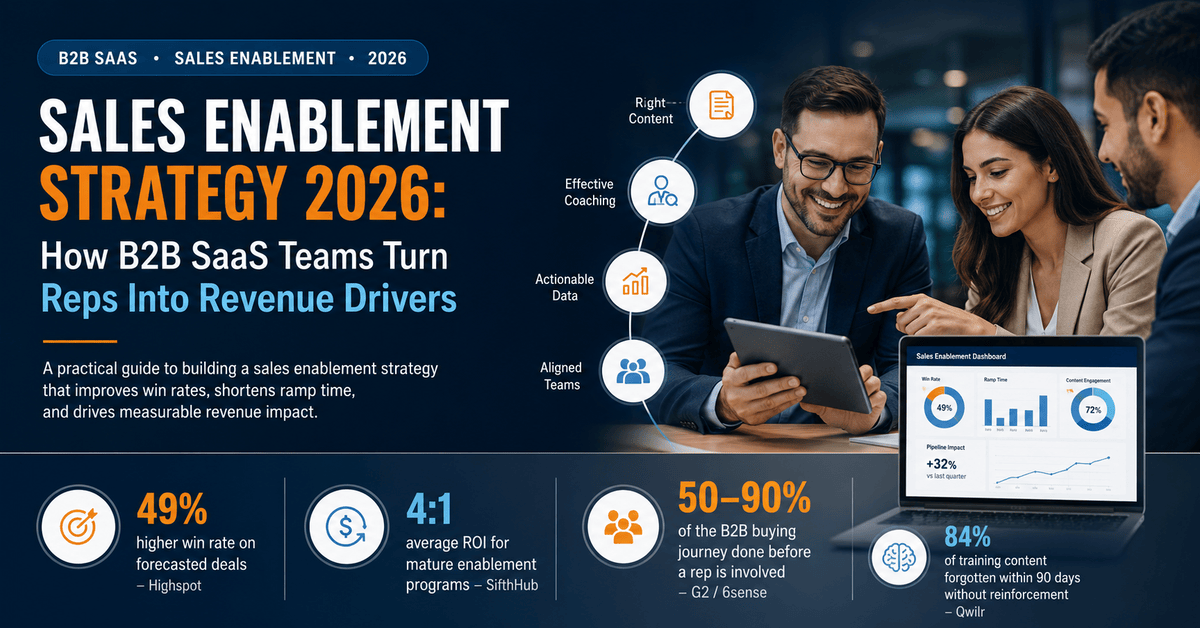
Sales Enablement Strategy 2026: How B2B SaaS Teams Turn Reps Into Revenue Drivers
Table of Contents
- Introduction: Why Sales Enablement Is the Priority in 2026
- What Is Sales Enablement, Really?
- The Core Pillars of a Sales Enablement Strategy
- The MarTech Panthers Sales Enablement Framework
- Sales Enablement Tools: What to Look For
- Sales Enablement vs. Sales Operations vs. CRM
- Common Sales Enablement Mistakes to Avoid
- Mini Case Study: Fixing a Broken Ramp Process
- The Future of Sales Enablement
- Frequently Asked Questions
- Conclusion
Blog Summary
This article is a practical guide for B2B SaaS revenue leaders looking to build or fix a sales enablement strategy in 2026. It covers what enablement actually means, the core pillars every program needs, a step-by-step framework, tool selection criteria, common mistakes, and how to measure ROI in terms your CFO will accept.
Introduction: Why Sales Enablement Is the Top Priority for B2B SaaS in 2026
Your reps aren’t short on effort. They’re short on the right content, the right coaching, and the right data at the right moment in a deal.
That gap is exactly what sales enablement is built to close. Done well, it’s the difference between a sales team that scrambles for the right case study five minutes before a call and one that walks into every conversation prepared, confident, and aligned with what marketing already promised the buyer.
Sales enablement has moved from a “nice-to-have” support function to a board-level line item. Organizations with formal enablement programs report win rates as high as 49% on forecasted deals — compared to roughly 42% for teams without one — and mature programs return close to four dollars for every dollar invested. If your sales team is missing quota, churning reps, or watching deals stall mid-funnel, the fix usually isn’t “hire more SDRs.” It’s building an enablement strategy that actually works.
By the end of this guide, you’ll know what sales enablement means in 2026, the framework top-performing B2B SaaS teams use, the tools worth investing in, and the mistakes that quietly sink most programs before they get off the ground.
| STAT | INDUSTRY INSIGHT |
| 49% | win rate on forecasted deals with a formal enablement program (Highspot) |
| 4:1 | average ROI for mature sales enablement programs (SifthHub) |
| 50–90% | of the B2B buying journey done before a rep is involved (G2 / 6sense) |
| 84% | of training content forgotten within 90 days without reinforcement (Qwilr) |
What Is Sales Enablement, Really?
Sales enablement is the ongoing practice of giving sales teams the content, training, coaching, data, and technology they need to have better conversations with buyers — at every stage of the deal, not just onboarding.
It’s easy to confuse it with sales training. Training is an event. Enablement is a system. A single onboarding bootcamp teaches a rep what to say on day one. Enablement makes sure that rep still knows what to say — and has the right battlecard or pricing sheet on hand — eighteen months later, in a completely different deal.
Core Components of Sales Enablement
- Content enablement: Case studies, one-pagers, battlecards, and ROI calculators mapped to buyer stage
- Onboarding and ramp plans: Structured 30-60-90-day paths with certification checkpoints
- Coaching and reinforcement: Call review, role-play, and manager scorecards tied to outcomes
- Competitive intelligence: Battlecards and positioning that keep reps sharp against alternatives
- Sales-marketing alignment: Shared lead definitions, SLAs, and joint content planning
When content, coaching, and CRM data feed each other continuously, they form a self-improving revenue engine. Every won deal sharpens the next playbook. Every lost deal surfaces a content or coaching gap.
This is the foundation that separates high-performing B2B SaaS sales teams from teams still recreating the same deck from scratch every quarter.
The Core Pillars of a Sales Enablement Strategy
Most mature enablement programs are built on four connected pillars. Skip one, and the whole system leaks value.
| Pillar | What It Covers | What Breaks Without It |
| Content Enablement | Case studies, battlecards, ROI tools mapped to buyer stage | Reps recreate content from scratch, or use outdated versions |
| Training & Onboarding | Structured ramp plans, certification, role-specific playbooks | New hires take 9–15 months to reach full productivity instead of 6–7 |
| Coaching & Reinforcement | Call reviews, role-play, manager-led feedback loops | Up to 84% of training content forgotten within 90 days |
| Sales-Marketing Alignment | Shared lead definitions, SLAs, joint content planning | Marketing produces content sales never opens; messaging drifts apart |
Each pillar needs an owner, a cadence, and a metric — otherwise it becomes a folder of PDFs nobody opens. If you’re still untangling how marketing automation and CRM data should feed into this, our breakdown on marketing automation vs. CRM is a good starting point before you build the enablement layer on top.
The MarTech Panthers Sales Enablement Framework
Here’s a practical, five-step framework we use when helping B2B SaaS clients stand up or fix an enablement program.
1. Map the Buyer Journey to Content Gaps
Review 5–10 recent won and lost deals. At each stage — awareness, evaluation, negotiation — ask what the rep had versus what they wished they had.
2. Build a Single Source of Truth
Reps shouldn’t be searching four different drives for the current pricing deck. Centralize content in your CRM or a dedicated enablement platform.
3. Design a Ramp Plan With Checkpoints
Break onboarding into 30-60-90-day milestones, each with a certification or live call requirement — not just a training module to click through.
4. Build a Coaching Rhythm
Weekly call reviews, monthly role-play sessions, and a manager scorecard tied to actual deal outcomes, not attendance.
5. Measure What the CFO Cares About
Track win rate by cohort, time-to-first-deal, quota attainment, and content usage — not just “completion rate” on a training module.
Sales Enablement Tools: What to Look For
The enablement tech stack has gotten crowded — most organizations now run three or more dedicated tools alongside their CRM. Before adding another subscription, evaluate against these criteria:
- Native CRM integration — a tool that lives outside your CRM won’t get adopted
- Content analytics — know which assets actually influence closed-won deals
- Coaching and call intelligence — AI-assisted call review that flags objection handling
- Role-play and simulation — structured practice environments before reps face a real buyer
- Reporting tied to revenue, not just activity
Choosing the Right Enablement Stack for Your Team Size
| Team Size | Recommended Starting Point | Budget Range |
| 1–10 rep team | HubSpot Sales Hub + native playbooks/sequences | $500–$1,500/month |
| 10–50 rep team | HubSpot / Salesforce + dedicated content & coaching platform | $2,000–$6,000/month |
| 50+ rep / enterprise | Full revenue enablement platform + AI call intelligence + LMS | $8,000–$25,000/month |
If your team already runs on HubSpot, it’s worth reviewing our guide on maximizing ROI with HubSpot before layering a separate enablement platform on top.
Sales Enablement vs. Sales Operations vs. CRM
These three get lumped together constantly. Here’s the clean distinction:
| Function | Primary Focus | Owned By | Example Output |
| Sales Enablement | Equipping reps to sell better | Enablement / RevOps lead | Battlecards, coaching, ramp plans |
| Sales Operations | Process, territory design, compensation | Sales Ops | Quota models, pipeline reporting rules |
| CRM | System of record for customer and deal data | RevOps / IT | Contact records, deal stages, activity logs |
Enablement uses CRM data to know what’s happening in the pipeline. If your CRM foundation itself is shaky, enablement will struggle no matter how good the content is — our piece on why CRM is essential for digital transformation is a useful companion read here.
Common Sales Enablement Mistakes to Avoid
Treating Enablement as a One-Time Event
A single onboarding bootcamp with no follow-up coaching fades fast — most training content is forgotten within 90 days without reinforcement.
Letting Marketing Build Content in Isolation
Content built without sales input rarely matches what reps actually need mid-deal, so it goes unused.
Measuring Activity Instead of Revenue
Tracking “content created” or “modules completed” doesn’t tell you whether enablement is actually moving deals forward.
Buying Software Before Fixing the Process
AI tools and platforms amplify a broken sales process just as easily as they amplify a good one.
MISTAKES TO AVOID CHECKLIST
- Enablement is treated as a continuous system, not a one-time event
- Sales has direct input into content creation
- Win rate and revenue impact are tracked, not just completion rates
- Sales process is reviewed before new software is purchased
- Coaching happens on a fixed weekly or bi-weekly cadence
- Sales and marketing share the same lead-scoring definition
Mini Case Study: Fixing a Broken Ramp Process
A mid-sized B2B SaaS company came to us with a familiar problem: new sales hires were taking close to ten months to hit full quota, and first-year turnover was high. Their “enablement” consisted of a three-day onboarding bootcamp and a shared folder of old decks.
What Changed
- Content was audited and cut from 400+ files to a curated 40, tagged by deal stage
- A 30-60-90-day ramp plan replaced the one-time bootcamp, with a live call certification at each checkpoint
- Weekly manager-led call reviews were introduced, tied to a simple coaching scorecard
- Marketing and sales agreed on a shared lead-scoring definition, closing a long-standing alignment gap
Sales Enablement Checklist
QUICK INTERNAL AUDIT
- Single, tagged content library reps actually use
- Onboarding includes certification checkpoints, not just modules
- Coaching happens weekly, with a documented scorecard
- Sales and marketing share a lead definition and SLA
- Win rate and ramp time are tracked — not just content downloads
- CRM data is clean enough to trust for enablement reporting
- Someone explicitly owns the enablement function
The Future of Sales Enablement
A few trends worth watching as you plan budget for the year ahead:
1. AI-Assisted Coaching Becomes Standard
Call analysis and role-play simulation tools are increasingly built directly into CRM and enablement platforms, rather than sold as separate point solutions.
2. Enablement Shifts Toward Existing-Customer Growth
With many revenue leaders now prioritizing expansion over new-logo growth, enablement content is expanding to cover upsell and renewal conversations.
3. Revenue Attribution Becomes the New Bar
Enablement teams that can tie their work directly to pipeline and win-rate movement are the ones getting budget increases.
4. Platform Consolidation
Expect fewer, more integrated tools rather than a sprawling stack of point solutions that don’t talk to each other.
Frequently Asked Questions About Sales Enablement Strategy
What is the difference between sales enablement and sales training?
Sales training is a one-time or periodic event that teaches specific skills. Sales enablement is the ongoing system — content, coaching, tools, and process — that keeps those skills sharp long after training ends.
Who should own sales enablement — sales or marketing?
It varies by company size. In many organizations, enablement sits under sales or RevOps but works in close partnership with marketing on content.
How do you measure sales enablement ROI?
Track win rate by cohort, time-to-first-deal for new hires, quota attainment, and content usage tied to closed-won deals — not completion rates.
Do small B2B SaaS teams need a dedicated enablement function?
Not necessarily a dedicated hire, but every team benefits from a curated content library, a structured ramp plan, and a regular coaching cadence.
What tools are essential for sales enablement in 2026?
At minimum: a CRM with clean data, a centralized and tagged content repository, and some form of call recording or coaching tool.
How long does it take to see results from a new enablement program?
Most organizations start seeing measurable movement in ramp time and content usage within one to two quarters.
Does AI replace the need for sales enablement?
No — AI works best as a layer on top of a solid enablement foundation. Tools without process redesign produce faster activity, not better outcomes.
What’s the biggest risk in building a sales enablement program?
Measuring the wrong things. Programs that track completion rates instead of win rate and revenue impact struggle to justify their budget.
Conclusion: Your Sales Enablement Strategy Starts With One Good Decision
A strong sales enablement strategy isn’t about buying another tool or running one more onboarding session. It’s about building a system where the right content, the right coaching, and the right data show up at the exact moment a rep needs them — consistently, deal after deal.
Here are the five things to take away from this article:
- Start with the buyer journey. Map real won and lost deals to find your actual content gaps before building anything new.
- Centralize content. One tagged, curated library beats four scattered drives full of outdated decks.
- Build ramp plans with checkpoints, not one-time bootcamps that fade within 90 days.
- Coach weekly, not annually. Reinforcement is what makes training actually stick.
- Measure win rate and ramp time, not completion rates — that’s what protects your budget next cycle.
The B2B SaaS teams pulling ahead in 2026 aren’t necessarily the ones with the biggest sales teams. They’re the ones where every rep, regardless of tenure, can walk into a conversation as prepared as your best performer.
If you’re ready to move from patchwork enablement to a real system, MarTech Panthers specializes in exactly this work — from CRM and content audits to full sales enablement implementation for B2B SaaS teams.
References:
https://www.highspot.com/sales-enablement/sales-enablement-content-performance/
https://learn.g2.com/sales-enablement-statistics
https://qwilr.com/blog/sales-training-statistics/
About Martech Panthers
Martech Panthers is a leading marketing technology and CRM solutions company that helps businesses drive growth through automation, data-driven strategies, and digital transformation. The company specializes in CRM implementation, HubSpot consulting, marketing automation, email marketing, WhatsApp marketing, LinkedIn outreach, website development, and seamless system integrations. By combining innovative technology with strategic expertise, Martech Panthers enables organizations to streamline operations, enhance customer engagement, and maximize marketing ROI. With a strong commitment to client success and business growth, Martech Panthers empowers companies to build scalable, future-ready digital ecosystems.
📩 Ready to harness WhatsApp stories for your business? Let’s talk.
📞 Call us: +91 9762910165
📧 Email:info@martechpanthers.com
🌐 Visit: https://martechpanthers.com/