
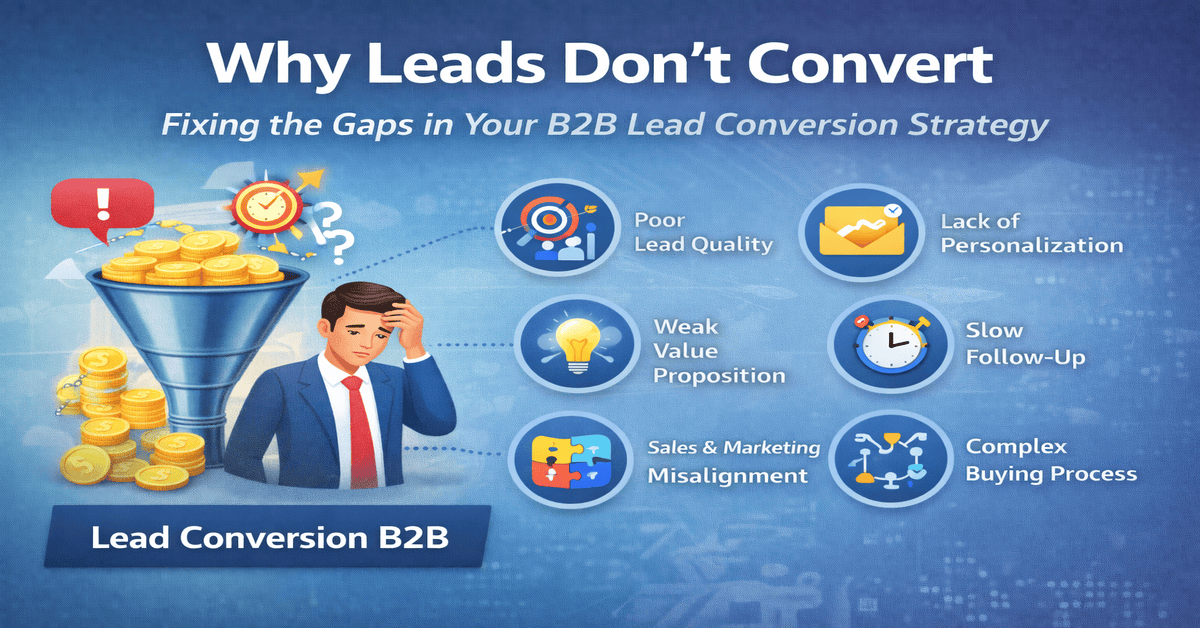
Why Leads Don’t Convert: Fixing the Gaps in Your B2B Lead Conversion Strategy
Blog Summary
This blog explains why many B2B leads fail to convert despite strong lead generation efforts. It highlights that the problem often lies in lead quality, lack of personalization, slow follow-ups, weak value propositions, and misalignment between sales and marketing teams.
The blog emphasizes that B2B conversions are more complex due to long sales cycles, multiple decision-makers, and the need for trust-building. It outlines key challenges such as poor targeting, generic communication, and lack of credibility, along with actionable solutions like defining an Ideal Customer Profile (ICP), using personalized outreach, and improving response times.
It also stresses the importance of data-driven decision-making and tracking key metrics to optimize performance. Finally, it looks at the future of B2B lead conversion, where AI and automation will play a major role in improving efficiency and personalization.
Overall, the blog provides practical strategies to identify conversion gaps and improve revenue outcomes.
Introduction
Generating leads is only half the battle in B2B marketing—the real challenge is converting them into paying customers. Many businesses invest heavily in lead gen but see weak pipeline results.
If leads aren’t converting, it’s often quality, strategy, or execution issues, not quantity. Improving lead conversion in B2B demands understanding buyer behavior, team alignment, and targeted fixes.
In this blog, we break down top reasons and solutions.
What is Lead Conversion in B2B?
Lead conversion turns prospects into qualified opportunities—and customers. Unlike B2C, B2B involves:
- Longer cycles (70-150+ days average, per industry).
- Multiple decision-makers.
- Trust-building via value proof.
Top Reasons B2B Leads Don’t Convert
- Poor Lead Quality
Broad targeting attracts unfit prospects (e.g., wrong industry/roles). 98% of visitors don’t convert without fit.
Solution: Define ICP (e.g., 50-500 employee SaaS firms) and use intent data. - Lack of Personalization
Generic blasts kill interest.
Solution: Tailor by industry, size, pain points (e.g., via dynamic emails). - Weak Value Proposition
Unclear benefits? No forward movement.
Solution: Lead with outcomes (e.g., “Cut costs 30%”) over features; test messaging. - Slow Follow-Up
5-min response = 21x higher conversions vs. 30-min delay; 78% buy from first responder.
Solution: Automate with tools like Outreach/HubSpot; aim for hours max. - Sales-Marketing Misalignment
79% of leads fail here; marketing chases volume, sales wants quality.
Solution: Shared lead scoring in CRM; weekly feedback loops. - Complex Buying Process
Multi-stakeholder hurdles cause delays.
Solution: Stakeholder-specific content (demos, ROI calculators). - Lack of Trust/Credibility
No proof = no deal.
Solution: Add testimonials, case studies, third-party reviews.
How to Improve Lead Conversion in B2B
- Define ICP: Target precisely.
- Personalize Interactions: Segment outreach.
- Speed Up Responses: Under 5 mins ideal.
- Align Teams: Unified CRM/processes.
- Use Data: A/B test continuously.
Key Metrics to Track
| Metric | Benchmark (2026) |
| Visitor-to-Lead | 2-3% |
| Lead-to-MQL | ~30% |
| MQL-to-SQL | 10-15% |
| SQL-to-Customer | 20-30% |
| Sales Cycle Length | 90-130 days |
Future of B2B Lead Conversion
AI/automation enables:
- Predictive scoring.
- Hyper-personalization.
- Real-time tweaks—even for small teams.
Conclusion
Leads fail from poor fit, delays, and disconnects—not just gen volume. Fix with ICP, speed, alignment, and data to boost B2B conversions and revenue.
Refine now for scalable growth.
Reference :
- https://www.hubspot.com/sales/lead-conversion
- https://www.salesforce.com/resources/articles/lead-conversion/
- https://www.marketo.com/articles/lead-conversion-strategies/
- https://www.forbes.com/sites/forbesbusinessdevelopmentcouncil/
📩 Ready to harness WhatsApp stories for your business? Let’s talk.
📞 Call us: +91 9762910165
📧 Email:info@martechpanthers.com
🌐 Visit: https://martechpanthers.com/